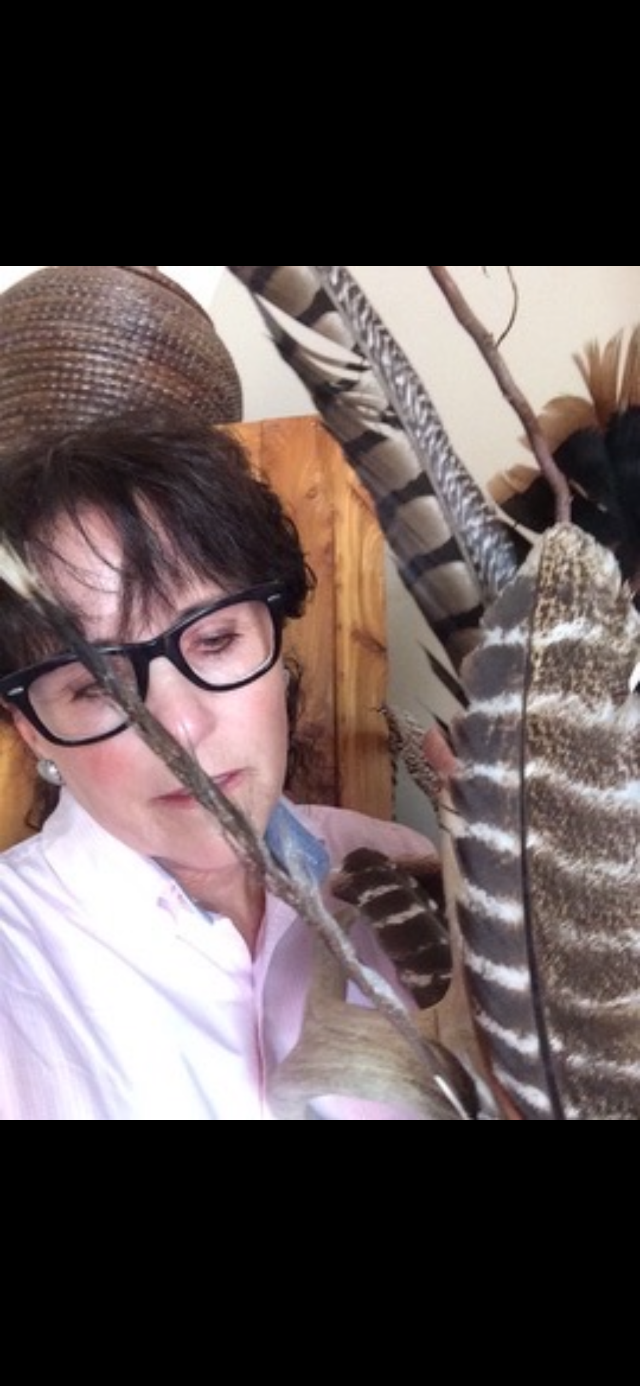
Raised amid the wide skies, mesas and volcanic fields of Northeast New Mexico, Lynne Darrah's art is steeped in the spirit of the West. She was born into a family whose lives were intimately tied to the land and her grandparent's cattle ranch. The ranch, known as the Bar-Box-T, was situated on the lower slope of Sierra Grande Mountain. The comforting heart of the ranch was the ranch house. It was alive with her grandmother's landscape paintings, a vibrant testament to the beauty and exquisite drama of the region's landforms. At twelve, Darrah felt the tug towards painting herself, a calling that continued to shape her life.
Darrah's early artistic education came not from formal studies, but from the world around her and the inventive, artistic traditions of her family. Her grandmother talked a lot about color, composition and how to create a natural randomness of the elements in a painting. She learned these principles while taking summer painting classes in Taos during the Great Depression.
At the time, a young ranch woman staying alone in Taos to attend classes was a scandal among the neighbors, but set the stage for her Grandaughter to be equally bold. Her grandfather was a self-taught geologist who worked in groundwater exploration and water- well drilling.
Following in her grandfather's footsteps, Darrah pursued a career in geology. While in college, she lived with a family on a ranch in Oklahoma. Part of the ranch's livelihood, to which everyone was expected to contribute, involved harvesting wheat, corn, bean and rice from Canada to Mississippi. Harvest seasons required the extended ranch family to travel and work in rural areas in ever-changing terrains. This exposure to landscapes spanning a wide swath of America fostered a deep appreciation of th region and an understanding of its vastness.
After graduation, environmental geology became her profession, but her artist's spirit endured. With little time to create art of her own, she became an early collector of the paintings of others. Among her most beloved artists were created by Oleg Stavrowsky, Frank Howell, Walt Wooten, Suzanne Baker, Kevin Redstar and JE Knauf.
As her career and family responsibilities became less demanding, Darrah began painting herself. A student at heart, she found great joy in learning the whys and hows of oil painting. Beginning with human portraits, she soon transitioned to painting animals.
Animals are central to Darrah's work - not as backdrops, but as subjects with agency, presence, and above all, personality. "Animals speak to me more than humans," she notes, and it's this profound connection she invites viewers to discover in her work.
Her creative process begins with sketching, often on gessoed wood - sometimes on doors, which provide a strong, smooth surface for her largest works. Faces are central to her compositions; she seeks not merely a striking likeness, but the moment when the animal's gaze seems to meet the viewer's, inviting a silent conversation that transcends species.
Her technique has evolved from gentle oil washes that mimic watercolor to richer, more saturated palettes layered to evoke textured fur, always emphasizing the individuality and inner life of her animal subjects.
Among her most ambitious works are depictions of animals in herds and packs, capturing their social dynamics. The backgrounds in many of her paintings are atmospheric, creating a sense of depth and space. Portraits of solitary creatures become meditations on presence and survival. The result is work that, as viewers often remark, seems to invites touch - strikingly realistic , without crossing into photorealism.
Outside the studio, Darrah's life is filled with horses, gardening, and long days hunting and fishing with her dog. At the heart of her work is the conviction that "animals are people too." Conservation is not merely a cause but a necessity, one that permeate her paintings as a reminder that humans are not the planet's only significant inhabitants.
Her greatest wish is for her work to enter people's homes and serve as a bridge between people and wild creatures, rekindling the sense of kinship many have lost.
* Currently showing at 200 N Gunnison, Lake City,CO 81235
* Currently showing at Marks Arts, 1307 N Rock Road, Wichita, KS 67206